Our last day in Savannah we were watching “Diners, Drive Ins and Dives” and The Early Bird Diner in Charleston was featured. As it turned out, it was just down the road from our RV park so we decided to stop for breakfast before heading in town to Ft. Sumter. I didn’t notice that I was reflected in the door when I took the picture of the outside.


The inside is typical diner décor with some local artists featured.

Our breakfast was very good, but later on Greg’s didn’t settle too well with him. Usually when we eat out we split whatever we order, but breakfast is an exception since I don’t eat eggs and Greg always wants eggs. This morning I had their pancake special which was corn flake pancakes with a double berry drizzle. An order came with 3 pancakes, I asked for only two, should have asked for just one, I couldn’t eat all of it.

This is our destination for the day. Ft. Sumter can be reached only by boat so we will meet our tour boat here. There is a museum to go through while we wait. Although this is a national monument our senior pass wasn’t good here. The fee is for the boat ride, not the entrance to the monument.

In early 1865 Charleston families buried valuables and heirlooms fearing they would be taken by the Union troops if Charleston fell. This particular set belonging to Mrs. William Jefford is referred to as “cabbage patch” porcelain because Mrs. Jefford buried it in the family garden and planted cabbages over it.

Construction of Ft. Sumter began in 1829 as part of the series of coastal forts built by the United States after the War of 1812. It was designed for 135 guns and a garrison of 650 men.
In December 1860 Ft. Sumter stood 55 feet above the water at low tide and the walls ranged from 9-25 feet high. However, it was only 90% complete, standing empty with only 15 cannons mounted and ready.
This is what the fort would have looked like at the beginning of the Civil War.

If you want to see a rehabilitated fort that does a good job of depicting life in the fort, Fort Pulaski is where you should visit. If you only want to stand where history was made, Ft. Sumter will be of interest. I’ll try to make the history summary short.
December 20, 1860 South Carolina was the 1st state to vote to secede. Four forts defended the port of Charleston at this time, Ft. Moultrie, Ft. Johnson, Castle Pinkney and Ft. Sumter. Very few Union soldiers were in any of the forts.
December 26, 1860 Maj. Robert Anderson who was in charge of 85 Union soldiers at Ft. Moultrie decided that Ft. Moultrie was indefensible and moved his troops secretly to the unfinished Ft. Sumter.
December 27, 1860 South Carolina volunteers took over the other 3 forts and began adding additional batteries around the harbor.
January, 1861 a merchant vessel carrying 200 men and supplies for Ft. Sumter was turned back by the South Carolina volunteers.
April 4, 1861 after one month in office, President Lincoln sent a relief expedition of merchant ships protected by ships of war to resupply the Union troops at Ft. Sumter.
April 10, 1861 the Confederate secretary of war got word of the upcoming resupply and telegraphed Brig. Gen. Pierce Beauregard who commanded the Confederate forces in Charleston to demand Ft. Sumter evacuate and if refused to reduce it in whatever manner he chose.
April 11, 1861 Beauregard demanded surrender, Anderson refused.
April 12, 1861 at 3:20 a.m. the Confederates informed Anderson that their batteries would open fire in one hour.
April 12, 1861 at 4:30 a.m. a signal shot was fired over Ft. Sumter. Within moments Edmund Ruffin of Virginia touched off a gun in the battery at Cummins Point headed to Ft. Sumter. By daybreak all forts and batteries were firing on the fort.
April 13, 1861 Anderson agreed to a truce and the fort was occupied by Confederate troops. The Civil War had begun.
In 1863, two years after the signal shot that started the Civil War, Ft. Sumter’s determined Confederate soldiers kept Federal land and naval forces at bay for 587 days. In the summer of 1863 Federal forces gained control of Ft. Johnson and began the bombardment of Charleston, which continued until February 17, 1865, the longest siege in U.S. Military history.
Well, that wasn’t as short as I anticipated, but history is why we are here.
Waiting on the deck for our tour boat to come in.


This group of barges and a tugboat pulled up looking like they were going to dredge something – note the huge scoop on the left end of the barge.

All we ever saw them bring up was water.

They did dump some of the water in a barge that said “New York, New York” on it. It kind of looked like they were washing off part of the barge. Greg said the barge was probably hauling garbage from New York (we don’t know that).

This bird was watching the action too.

This big guy coming in is from Panama.

A tugboat is turning it and pushing it in to dock so it can be loaded with waiting cars and boats.


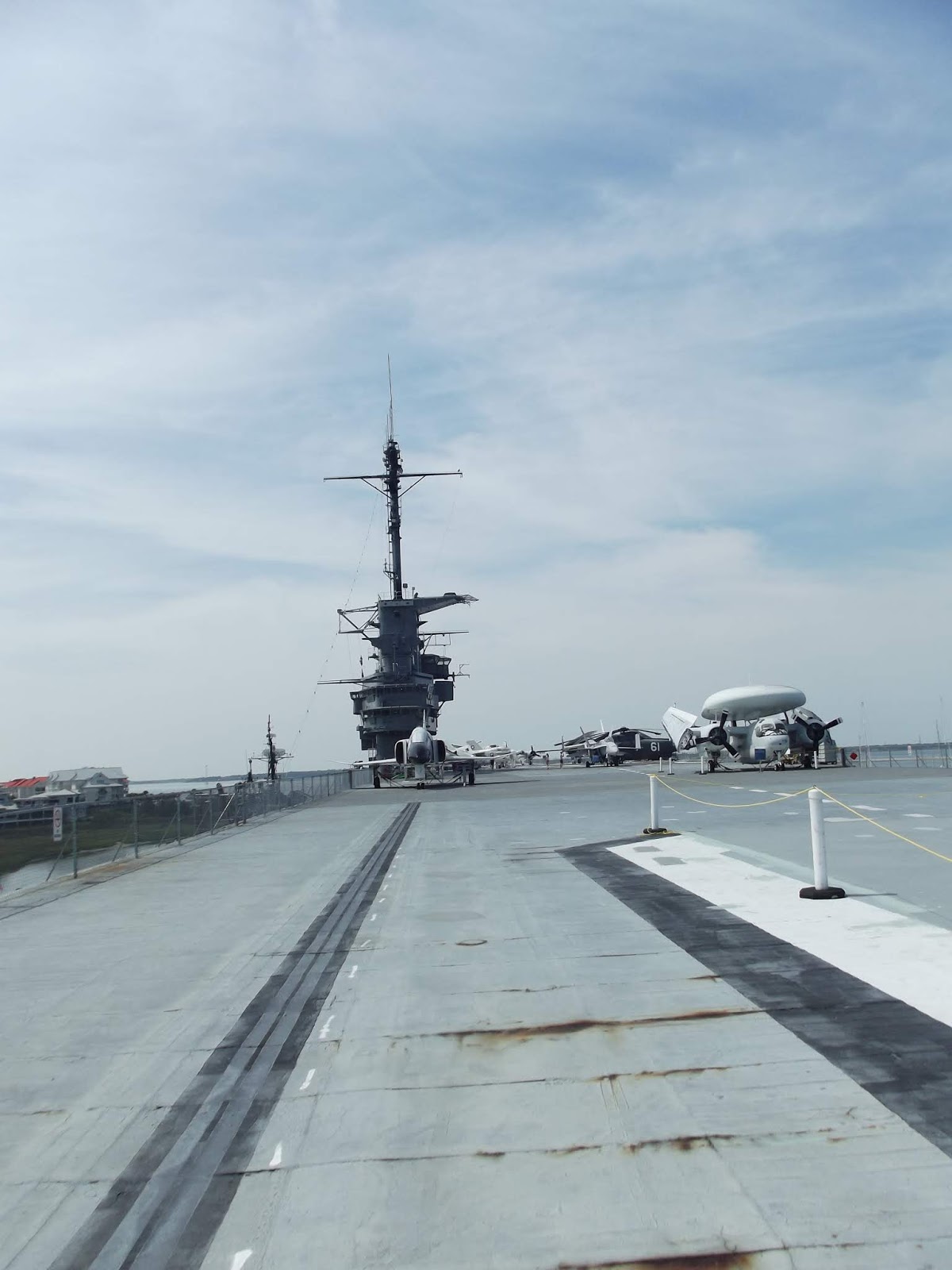
A few people were parasailing. The carrier in the background is the one we toured yesterday.

Our tour boat has arrived.

As we board, I check out where the life jackets are loaded, under the tarp above us – safety first especially when you can’t swim!

Next time through this area a tour on this tall ship might be in order.

Getting ready to dock at the fort.

An outside view of the fort.

Walk around the outside.

In 1899 the fort was modernized by the addition of a steel reinforced concrete battery in the middle of the parade grounds. The fort was used through World War II and finally decommissioned in 1947. These inside views taken from atop the battery show the nearly total destruction of the fort.


Back at the museum.