This tour
was Greg’s suggestion and I am so glad he made it, what an interesting
place. If you get the chance to go,
definitely opt for the 90 minute tour rather than the 30 minute one.
We had to
wait a bit for our tour time so we walked down the Daytona 500 Champions Walk
of Fame.
Our favorite
drivers have been winners.
This place
is huge.
This
“Daletona” mosaic artwork made up of very small pictures commemorates the
career of Dale Earnhardt, Jr.
We killed a
bit more time in the gift shop.
The tour is
about to begin.
These
tunnels are original to the track. At
the time the track was built the drivers drove their cars through these
tunnels, there were no semi-truck haulers to move them in.
We weren’t
able to get out on the track today because of some testing being done. The 31
degree banking is a little hard to appreciate from this angle.
During the
races, personnel occupy the Sunoco tower looking for debris or problems on the
track.
These are
the current tunnels that will accommodate the semis and RVs.
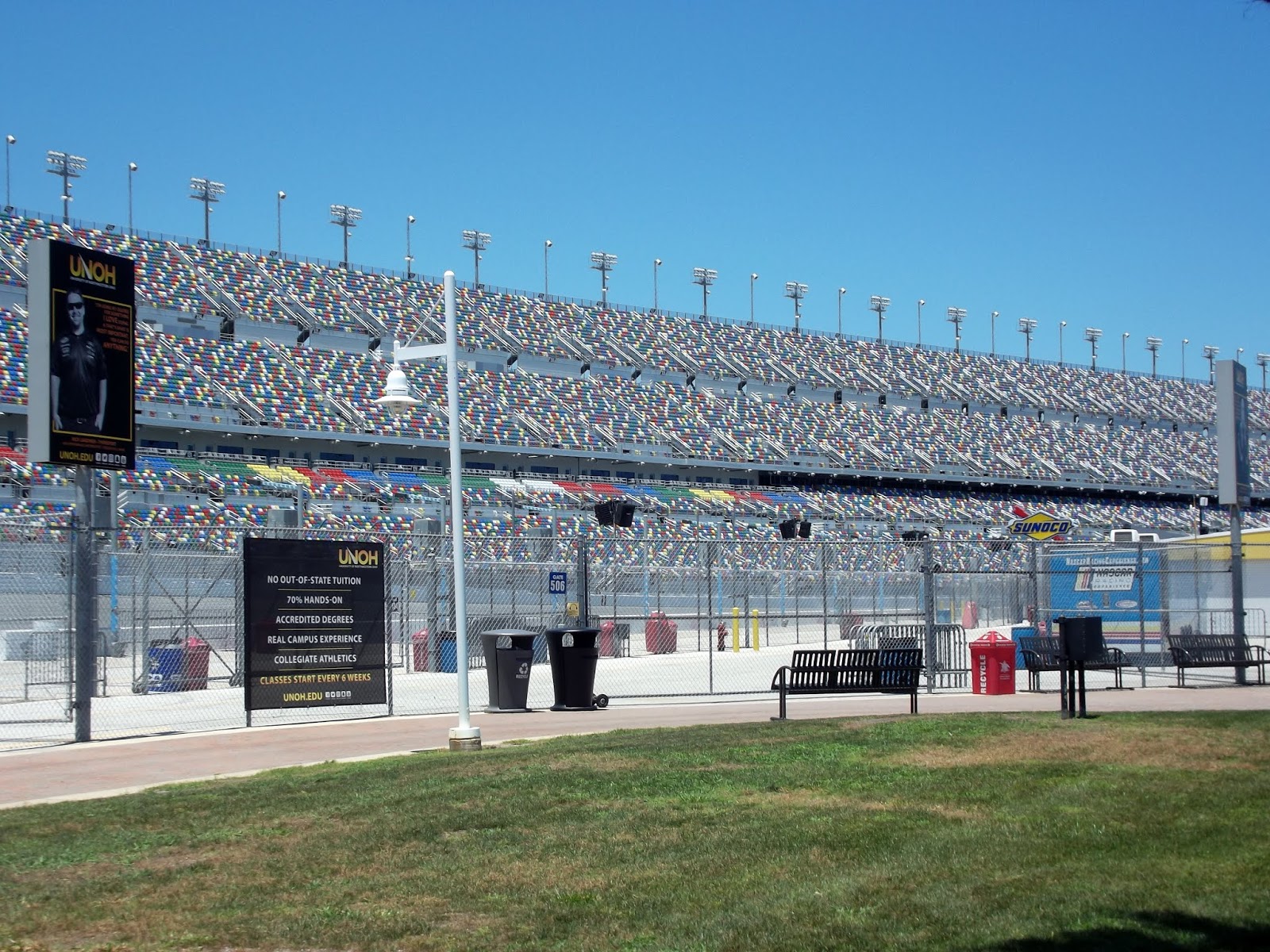
You have to
be really far back to get all of the grandstand seating in one picture.
The black
and white seats are prime seating. From
them you can see not only the race but the victory lane celebrations as well.
The
multicolored seating makes it look like the area is filled even if it’s not.
We made a
“get out of the trolley” stop at Fan Zone.
The
University of Northwestern Ohio sponsors the Fan Zone. I found that odd until they mentioned that
the university has a high performance motorsports technology curriculum.
The blue
garages are for the Xfinity cars.
We also
spent some time in Victory Lane.
The green
seats in Victory Lane are for the members of the press.
If you
belong to the Daytona 500 Club which is in special rooms above Victory Lane
your food and drinks are included in the price of your ticket. Our tour guide dodged a lot of questions
about the cost – he wouldn’t say, but I think it is a safe bet that we won’t
ever be there.
Since the
Daytona 500 Club is above Victory Lane they don’t really have a very good view
of the happenings in the lane so special seating is provided for them.
We are
headed into the Media room.
There is
assigned seating when the big day arrives.
All the
connections they need are at every station.
This is the
stage and table where the winners are interviewed after the race.
Just think,
the next winner will be thinking, “this is where Greg and Diana Jones sat”.
This is the
RV park for the owners and drivers.
There is a separate area for race attendees’ RVs.
The blue car is the reason we couldn’t get on the track today.
There are 3
solar panel covered rest areas around the facility providing electricity for
the complex.
We are 13
stories high in the black and white seats looking toward Victory Lane.
Fan Zone
from the black and white seats. The
large metal structure holds the jumbotron screen. When it isn’t in use it is taken down for
safety.
The yellow
garages are for the Cup Series cars.
The airport
in the background makes getting to the race very convenient for those who fly
in their own plane or a charter flight.
The flag
stand and finish line down below. Note
that the grass doesn’t look like it does for the Daytona 500. Some motocross events have dirt brought in
which covers the grass. When it is
hauled out, the grass is reseeded and will be ready for the next race.
The finish
line continues outside the building.
Denny
Hamlin’s 2019 winning car just as it came off of Victory Lane.
I tried the
31 degree of banking exhibit. I couldn’t
walk up it. We saw some pictures of the
track being built that showed the machinery working on the track having to be
cabled to machinery on level ground up above to keep them from sliding down the
track.
The Daytona
500 trophy, a smaller replica goes to the winning driver each year.
Entering the
Motorsports Hall of Fame Museum.
In 1935 the
Campbell-Railton “Blue Bird” set a record on the sand in Daytona Beach at
276.82 mph. Later that year Campbell
became the first to exceed 300 mph on wheels at the Bonneville Salt Flats.
I’m a fan of
the movie “Cars”, so I was happy to see the Hudson Hornet.
Micky
Thompson brought the “Challenger II” to the Bonneville Salt Flats in 1968 to
pursue the land speed record for piston-powered cars. The Salt Flats were flooded so he went home
without making a run. The car sat for 42
years until his son Danny restored it and made attempts to set the record. He finally made it in 2018 with a new world
record of 448.757 mph.
Lots of
special cars on display.
Our family
and friends from Indiana might recognize this Pay Less Super Market car.
We’ve been
to St. Augustine before and we are looking forward to another visit today. In 1513 Ponce de Leon claimed Florida for
Spain. Pedro Mendez and 700 soldiers and colonists founded St. Augustine in
September 1565 making it the oldest continually occupied European settlement in
North America. The town was burned and
rebuilt several times, the last time was in 1702 so none of the buildings in
current St. Augustine are any older than that.
On our way
we crossed over the Dames Point Bridge.
It is 2 miles long and 175 feet high.
My pictures don’t do it justice.
We parked in
the very ornate parking garage across from the visitor’s center. This garage is within walking distance to
everything in old town St. Augustine.
Cost per day is $16.
The
visitor’s center isn’t nearly so ornate and unfortunately needs a little scrub.
The inside
of the visitor’s center is much nicer than the outside.
You would be
surprised at how many people try to take their big trucks and SUVs down these
narrow brick streets.
This cute
bed and breakfast is called the Hemmingway House, not because Hemmingway has
ever been there, but because Hemmingway is the owner’s favorite author.
Our
destination for lunch is Harry’s Restaurant, the red building.
We opted for
outside seating.
Our
appetizer, bacon wrapped scallops on fried grit cakes, was amazing. Greg usually shies away from grits, but he
seemed to like them fried.
I had the
blackened shrimp salad and Greg had a chicken chef salad. Both were great choices.
Old St.
Augustine is right on the Atlantic Intercostal waterway, a continuous
navigation channel that begins in Virginia and ends in Key West. It provides a route for commercial and
recreational vessels that aren’t able to travel safely in the open ocean.
The Bridge
of Lions drawbridge spans the intercostal waterway connecting St. Augustine to
Anastasia Island. It was completed in
1927 and listed on the National Register of Historic Places in 1982.
As we approached, the bridge was closed but we could hear the announcement that the bridge would open in one minute.
The bridge
went up and a large sailboat made its way through.
This pirate
ship in the marina is an eye catcher. It
is used for tours.
This
beautiful building served as the Governor’s House from 1710-1812.
I was hoping
we could get into this building for a walk through, but everything was closed
up for some construction. This was previously
the very elite Ponce de Leon Hotel. It
is currently the main building of Flagler College. The hotel was built by Henry Flagler,
co-founder of Standard Oil. It was
completed in 1887. Tiffany and Company
provided the many stained glass windows in the dining room. Electricity was supplied by Edison Electric
Company. It was one of the first
buildings to be wired for electricity from the onset. It helped that Edison was a friend of
Flagler. I read that when the hotel
opened Flagler had to hire special people to just turn on the lights in the
rooms because many of the guests were afraid of electricity and wouldn’t do it
themselves.
The
beautiful windows in the dining room are hard to see from the outside because
they are now covered with Plexiglas. I
think they would still be very beautiful from the inside.
We were able
to see a few of the special artistic touches up close.
St. George
Street is the main street in Old St. Augustine.
We visited a
gourmet popsicle store for dessert – I had champagne mango. Neither the outside nor the inside were
picture worthy, but this stairway inside was very cute.
Lots of
artist alleys off of St. George Street.
Many of the
buildings are built of the same material as this wall, I think it is called
“coquina”.