What a great
day for a day trip, temps in the high 80s with lots of sunshine. About an hour or so from the resort where we
are staying.
Our first
stop was the White Sands Missile Range Museum.
At the close of WWII White Sands Proving Ground was established to test
the emerging rocket technology. Since
1945 the missile range has conducted more than 42,000 missile and rocket
firings. The literature on the range
says that once or twice a week when missiles are being fired Highway 70 will be
closed for an hour or so. Thank goodness
we missed that, it got really hot when we weren’t moving.
The museum
is located on an Army installation, but it is open to the public and admission
is free. You do have to show your driver’s
license, vehicle registration and proof of insurance for the vehicle. They say there is RV parking, but it looked
pretty tight to me.
Inside the
museum we spotted this mosaic of the “Missing Man Table” I thought our fellow Rolling
Thunder members would appreciate.
This Darth
Vader helmet was given to the museum by Ben Burtt of Lucas films. He visited the range twice in 1978 to collect
sounds of various missiles being test fired.
Many of those sounds were used in the movie “Star Wars”.
In the 1960’s
the Missile Dogs of White Sands were much more efficient at finding fallen
missile pieces than humans or instruments.
Before firing the missile, parts were coated with shark liver oil which
couldn’t be smelled by humans but the dogs picked up on it right away. They could usually find the missile pieces
within an hour.
On March 30,
1982 NASA’s Space Shuttle Columbia landed at White Sands Missile Range because
of flooding at the Shuttle’s original landing site, Edwards Air Force Base,
CA. The scheduled landing was to be the
day before but the worst wind and sand storm in 25 years came through the area
and delayed the landing a day.
This is a
1/3 scale model of the first nuclear device as it looked fully assembled and
sitting atop the 100 foot tower at ground zero, Trinity Site, which is here at White Sands.
Anyone
remember using one of these in high school business classes? Monroe desk calculator.
Lots of
missiles are located inside the museum.
This one is
a BGM-71 TOW. Its first use on
helicopters was on 5-2-72 when U.S. Army UH-1 Hueys destroyed North Vietnamese
tanks near Am Loc.
There was a
separate building outside housing a V-2 rocket that had been refurbished in
Hutchison, Kansas. Unfortunately, my
picture of it is blurry. The V-2 rockets
were developed by the Germans. At the
end of WWI German military buildup was limited by the Versailles Treaty. But rockets weren’t covered by that treaty so
Germany went in search of brilliant scientists and engineers who would devote
their time to rocket development, the first successful flight of the V-2 was in
1942.
By 1945
Germany had been defeated and Germany’s main scientist on the V-2 program and
his crew of nearly 100 scientists and engineers decided to surrender to the
United States rather than other allies because they thought they would be
treated better.
300 train
cars of V-2 parts were shipped to White Sands and the Navy started
participating in the V-2 testing program.
Sign at the
entrance to the outside display. I’m not
sure what rattlesnake protocol is – do you stand still, move away slowly or run
like the wind? (in my case I only have to run faster than Greg).
Lots of
different missiles outside.
I recognized
the name of this Patriot Missile. It was
first fired in 1970. It was developed as
a defense against high performance aircraft.
Note: There is no white sand here that we could
see.
I am so glad
we decided to go another 30 miles to the White Sands National Monument. This is part of the National Park Program so
we got in free with our Senior Pass.
This is what
the desert looks like leading up to the White Sands National Monument.
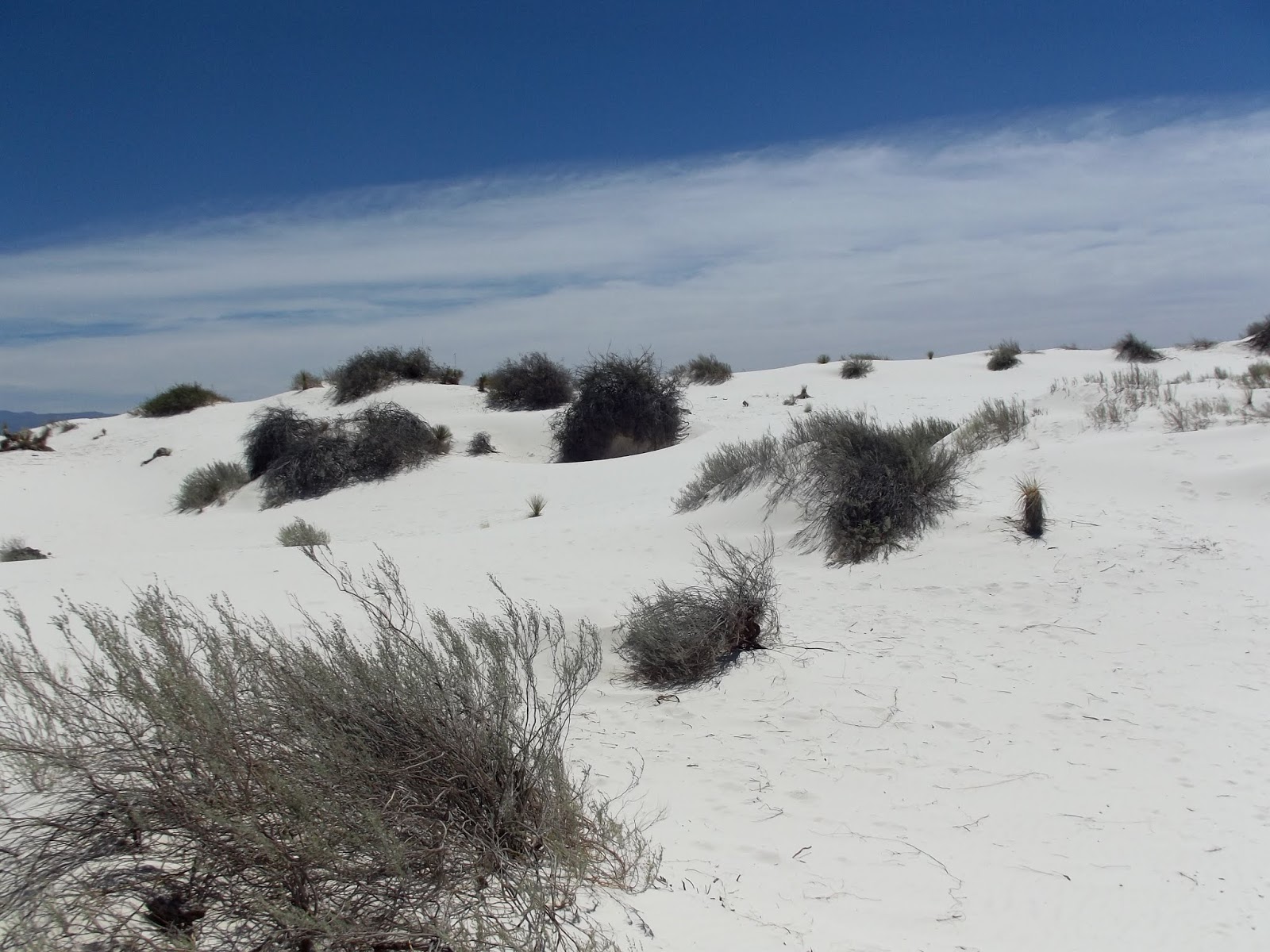
Then it turns to this, looking like snow
drifts in the desert. At one point one
of the sand dunes was beginning to encroach on the road, Highway 70.
The visitor’s
center had a short movie explaining how the dunes have developed.
The Tularosa
Basin is a mountain-ringed valley at the northern end of the Chihuahuan Desert. The eroding mountains around the basin fill
it with sediment including the gypsum that forms the white sands. This basin is like a bathtub with no drain so
rainfall during the monsoon season is trapped in the lowest point of the basin –
Lake Lucero and the Alkali Flat. When
the water evaporates beds of selenite crystals are formed like these.
Freezing and
thawing, wetting and drying eventually break down the crystals into particles
that are light enough to be moved by the wind.
As the particles continue to be blown by the wind they get smaller and
smaller until they are nearly as fine as talcum powder.
As the winds
continue to blow the newer dunes can move 12-15 feet a year. Older dunes with developed plant life move at
a slower rate of just a few inches a year.
Only a few plant can grow rapidly enough to survive being buried in the
moving dunes. One of them is the Yucca
plant. 10 feet of the plant might be
visible above the dunes, but the roots will go another 30 below the surface to
reach water. However, when the dunes
move away from the plant it can’t support this tall stem so the plant dies.
The Sumac
plant roots bring water from the ground and use the soft gypsum sand to create
an almost concrete like foundation for its plant.
The great
wave-like dunes of gypsum sand have engulfed 275 square miles of desert here
and have created the largest gypsum dune field in the world.
The animal
life here has evolved to white versions of their former selves. We saw a lizard that was white, with just a
little turquoise showing on its tail.
However, it moved too fast for me to get a picture.
We hiked up
one of the dunes. That is the bike below
us. This picture is as it was taken, no
editing. We estimate we were 20-30 feet
up.
At the top
of the dune I wrote “5-1-15 Jones”. I’m
sure it was gone by the time we made it back to the visitor’s center.