Showing posts with label Savannah. Show all posts

Thursday, May 30, 2019

Georgia, Savannah - Friday, May 24, 2019 - Savannah Bee Company


With temperatures in the upper 90s feeling like over 100 we are looking for something that doesn’t require a lot of walking outside.  We read about the bee garden tours at the Savannah Bee Company and tried to book a time online with no success.  We are hoping we can talk our way into a tour when we show up.


Greg picked Molly McGuires for lunch.  We had trouble finding this place and once we found it a semi had an accident and was blocking the drive – no problem we have a Jeep, a little off road and we were there.


The entrance is interesting.


With all of the shade we opted for outside seating.


Someone was waiting for crumbs.


Thank goodness this guy wasn’t real.


We couldn’t decide so we had a variety of appetizers, crab dip, southwest egg rolls and pot stickers.


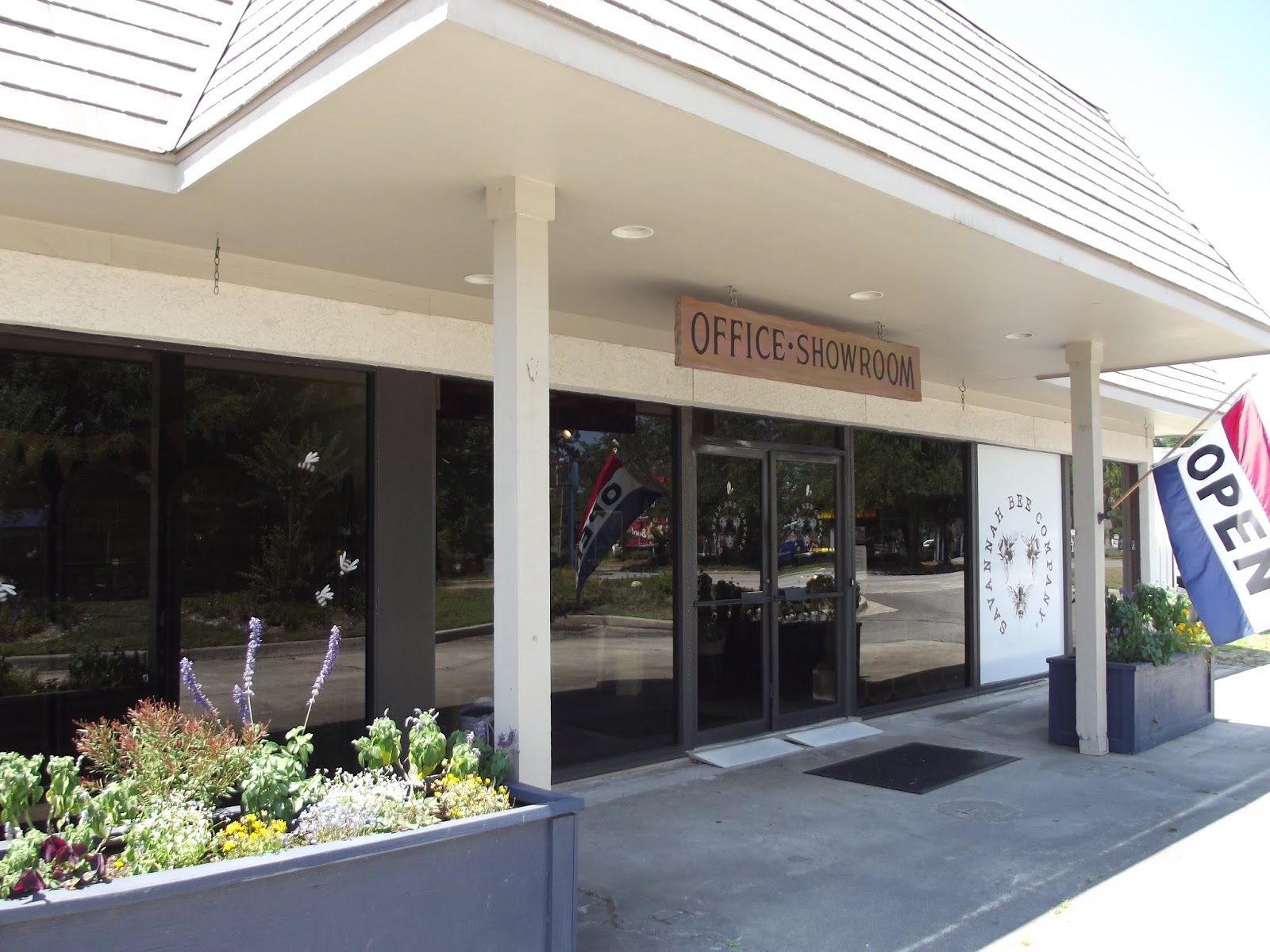
Here we are at the Savannah Bee Company


They have 3 or 4 sites but we chose this one because they have tours.  Our power of persuasion wasn’t going to get us a tour today.  Everyone but the one clerk in the store was at a beekeeper’s convention.


A working hive is on display in the showroom.


Who knew there were so many different kinds of honey?  The tasting is free and the clerk reminded us to taste slowly and give it some time between tastes so they don’t all end up tasting alike.


They have honey based cleansers, shampoo and creams and bee smokers (on the top shelf) if you find you need one of those.


Lots of honey for purchase.


Our purchase for the day, some orange blossom honey and lip balm.


Wednesday, May 29, 2019

Georgia, Savannah - Thursday, May 23, 2019 - Tybee Island and Ft. Pulaski


The drive to Tybee Island, I love these trees with moss.


We stopped at the North Beach Bar and Grill for lunch.  North Beach was incorporated in 1887.


The grilled fish taco was great.


Greg opted for a shrimp po’boy.  We shared the sweet potato fries which was drizzled with a balsamic vinegar reduction, different but good.


The boardwalk to the beach.


The beach is crowded today, the last time we were here it was in the fall and rainy so we almost had the beach to ourselves.  It was really hot out today so we didn’t stay long.


I still couldn’t convince Greg to climb to the top of the lighthouse.


We had to laugh because there is a sign that says the Battery Brumby is a “Severe Weather Safe Site” but all of the doors appear to be padlocked shut.


Greg wondered how long it would take a turtle to get across the road.


Ft. Pulaski is named for a Polish soldier who fought for Polish liberty against Russia.  When Poland lost he was forced to flee his homeland.  He met Benjamin Franklin in Paris in 1777 and Franklin inspired him to join America’s fight for freedom.  In 1778 Congress selected him to command the newly formed cavalry unit and he became known as the “Father of the American Cavalry”.  He was fatally wounded in 1779 during the Battle of Savannah.

Construction of the fort began in 1829, long before the War Between the States was to begin.  Robert E. Lee, fresh out of West Point, took his first assignment as assistant engineer on the project.  The marshy ground on Cockspur Island had to be prepared for the heavy fort.  Lee conducted surveys, selected the exact site for the fort and began building the drainage and dike systems.

The view of the fort from the parking lot.  This is a national memorial so our senior pass got us in for free.


 Crossing the moat into the fort.  The moat is 7’ deep and is home to the occasional alligator.


This is a passageway to the gun placements outside the fort.  I was just glad there were no bats inside.


Massive doors were part of the defense of the fort.


The fort is built around this large grassy parade ground.


The breezes through these covered walkways was amazing on this very hot day.


Ten cisterns like this one stored 200,000 gallons of water.  Rain water came in through a series of pipes.  After the capture of the fort in 1862 Union soldiers supplemented the natural supply with a steam condenser which converted the moat’s salt water into fresh.


Col. Olmstead surrendered in this room on April 11, 1862.


Even though these cannons were built with a track so they could be moved, that had to be a major undertaking.


Thirty-one steep steps up a spiral stairway with no hand rail and you are on the top level.


Room for more cannons up here.  The fort was designed for 140 cannons.


On April 10, 1862, Confederates refused a demand to surrender because the enemy guns were a mile away on Tybee Island – more than twice the range of heavy artillery of the day.  However, the Union troops had new “rifled” cannons.  When they fired those spinning projectiles, they bored through the brick walls of the fort especially those in the area containing 40,000# of gun powder.  In less than 30 hours the Confederates were worried about being blown up by their own gun powder among other things.  They considered the situation hopeless and surrendered.

Inside the fort from above.


Cannons could have lined the walls.


It took 25 million bricks to build the fort.  Fingerprints of those who made the bricks can still be seen.


Confederate soldiers prepared for battle using earth and timbers to create a “bindage” to protect troops from incoming shells.  They also dug ditches in the parade ground to catch rolling cannon shot (I thought this was genius).


The commanding officer’s quarters.


The Federal medical dispensary.


It was hard to get a picture of this bird, I think it is a brown pelican.  Lots of these birds were diving into the water and catching fish for lunch.  Quite the spectacle, but hard to catch on film, I need to get comfortable with videos.


More trees with moss on the way home.


Tuesday, August 5, 2014

Georgia, Savannah - Tuesday, August 5, 2014 - Bull Street, Mercer-Williams House, Mansion on Forsythe Park


We thought our day might turn out bad when Greg discovered this morning that he no longer had his debit card.  We knew that the only place we used it yesterday was at Lady & Sons for lunch so we headed there as soon as we found a parking garage for the motorcycle.  I got a better picture today.
 
 
The people at Lady & Sons were expecting us.  In fact, they were surprised we weren’t back yesterday.  We used cash for our other purchases yesterday so we didn’t miss it until this morning.  We want to thank the staff there for watching out for us.

I hope no one from Savannah read our blog yesterday because I made a horrible mistake when I wrote that the Waving Girl Memorial was built for the 1996 Olympics.  The Waving Girl Memorial and the 1996 Olympics Memorial are both on River Street, but they are definitely not the same thing.
 
 
Savannah’s Waving Girl Memorial is a tribute to Florence Martus.  From 1887 to 1931 she greeted ships entering and leaving Savannah by waving a cloth during the day and a lantern at night.  Ships would return her greeting with three blasts from the ships' horn.  For more than 44 years she never missed greeting a ship.  The memorial was built by Felix De Weldon who also sculpted the Iwo Jima Memorial.

After retrieving our debit card, we headed down Bull Street in search of a few special sites and to just see the amazing architecture of the buildings along this street.  I understand that some of the more “gingerbread” type houses are in the Victorian District which is south of the Historical District where we are exploring now.
Chippewa Square, one of the 22 squares in the city, is the site of some of Tom Hanks’ scenes as Forrest Gump.  There were several benches around the square (I’m not sure which one Hanks used).


The Green-Meldrim Mansion served as General Sherman’s headquarters from December 1864 to February 1865.  The house was built in the 1850’s at a cost of $93,000.  We didn’t take the tour of the house but it is said that the detail of the interior is as sumptuous as any to be found in America.  The ironwork around these houses just amazes me.


We’ve seen SCAD all over Savannah.  We now know that SCAD stands for Savannah College of Arts and Design.  This building, a former Savannah Volunteer Guard Armory, was purchased in March 1979 and became the flagship building of an expanding campus.  All throughout the Historical and Victorian districts the college has restored numerous structures.


We liked the old shutters on the side of the building.


The Mercer-Williams house at 429 Bull St. was a focal point for the book Midnight in the Garden of Good and Evil.  It was designed in 1860 for Hugh W. Mercer.  Construction was interrupted by the Civil War and the house was not completed until about 1868.  In 1969, Jim Williams bought the house and took two years to restore it.  Mr. Williams was known as preservation and restoration expert as well as a lavish host.  He became even more famous as the central figure in “The Book” as the locals refer to Midnight in the Garden of Good and Evil.


The Book, which I just had to purchase today, is based on real-life events that occurred in the 1980’s.  It is constructed loosely around the shooting of a male hustler by internationally known antiques dealer Jim Williams in May 1981 and the subsequent four murder trials that lasted more than 8 years.  The Book, written by John Berendt, spent 216 weeks on the New York Times best seller list-the longest run in history.
 
In 1997 Clint Eastwood directed the movie based on the book.  Kevin Spacey starred as Williams.

The Alder House at 425 Bull St. was built in 1858 for the Reverend Charles Rogers.  This 5 bedroom townhouse is the home of Jim William’s arch rival, Lee Alder.  The feud between the two men who had different perspectives on preservation is supposed to be much covered in The Book.  It is directly across the street from the Mercer-Williams House.
 
 
I don’t know anything about this house except I liked the look of it.  It is across the street from the Mercer-Williams house on the opposite side from the Alder House.
 
This is a view of Monterey Square from the Mercer-Williams house.  Standing here looking around at the beautiful square and the historical homes that surround it, it is so easy to envision the life and times when these buildings were in their prime.


What originally caught my eye was the gold that accented the black ironwork on the Armstrong House.


The Armstrong House was finished in 1919 as a personal residence for George Ferguson Armstrong of the Strachan Shipping Company.  In 1935 with 175 students it became Armstrong Junior College and classes started in what the Atlanta Constitution called “the finest and most costly junior college in the United States”.  In 1959 the junior college became part of the University System of Georgia.  In 1966 it moved to a new campus.  In 1970 the house was acquired by members of the law firm of Bouhan, Williams & Levy (they are obviously doing quite well).

The Fountain at Forsythe Park is the focal point of this park that encompasses 30 acres, we just touched the northern part of it, we were getting tired and still had a long walk back to the motorcycle.
 
 
The Mansion on Forsythe Park is now an upscale hotel.  It was originally designed in 1888 as an 18,000 square foot Victorian homestead.  This was either a big family or they had lots of friends, it covers an entire city block.


This is a view of the restaurant in the hotel.
 
We went in and looked around, I’m sure security was on high alert as soon as we walked in, we certainly didn’t belong.  I did take time to snap a few pictures of an antique hat exhibit they have on display.